

CeraVe vs Vanicream Vitamin C Serum for Sensitive Skin
Research based skincare comparison
CeraVe vs Vanicream Vitamin C Serum
How to choose between 10% L-ascorbic acid and 5% THD ascorbate when sensitivity and uneven tone matter.
Affiliate disclosure: As an Amazon Associate, DSULABs earns from qualifying purchases. Retailer links below are affiliate links. Prices and availability can change.
The short answer
CeraVe is worth considering if you want a disclosed concentration of the active vitamin C form and already tolerate acidic serums. Vanicream is worth considering if you prefer a THD-based formula designed for sensitive skin. Neither choice has a demonstrated head-to-head advantage in the studies reviewed here. Your known sensitivities and the rest of your routine should guide the choice.
Consider CeraVe
You want L-ascorbic acid
Its 10% concentration is clearly identified. Check the complete formula, especially if products containing denatured alcohol have bothered you. Ceramides do not guarantee comfort. [1]
Check CeraVe on AmazonConsider Vanicream
You prefer a derivative formula
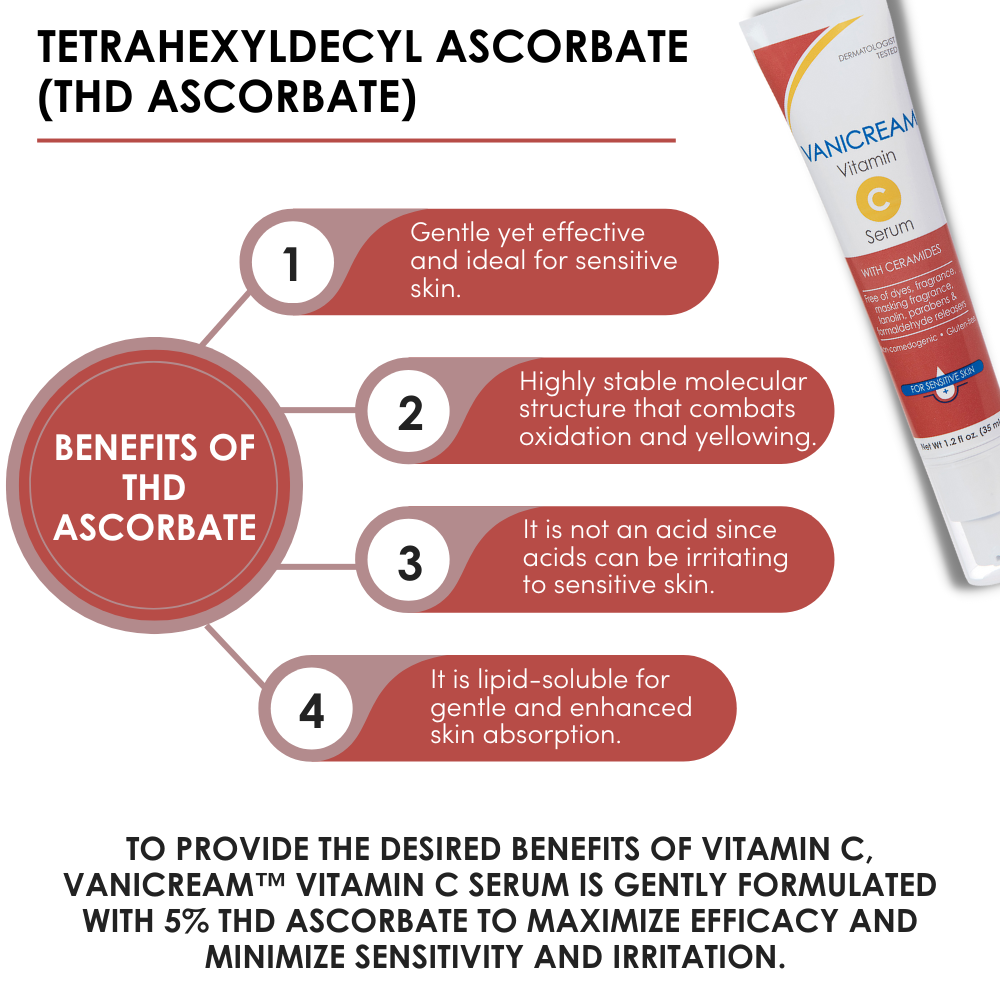
The brand's official gallery identifies 5% THD ascorbate. Sensitive-skin positioning is a reason to investigate the formula, not proof it will be gentler for you. [2]
Check Vanicream on AmazonBuy neither for now if your skin is actively irritated. Avoid adding another optional active to burning, peeling or inflamed skin. If reactions are persistent, severe or hard to explain, ask a qualified clinician. Vitamin C is optional; sun protection remains important. [8][9]
The useful differences at a glance
Manufacturer information identifies the products. It does not measure how either feels or performs on your skin. Check the package you receive because formulas and labeling can change.
| What matters | CeraVe Skin Renewing Vitamin C Serum | Vanicream Vitamin C Serum |
|---|---|---|
| Vitamin C | 10% L-ascorbic acid | 5% tetrahexyldecyl ascorbate (THD), disclosed in the official product gallery |
| US package | 1 fl oz / 30 mL | 1.2 fl oz / 35 mL |
| Formula details | Three ceramides, glycerin, panthenol and sodium hyaluronate; fragrance-free | Five ceramides and glycerin; without fragrance, botanical extracts or essential oils |
| Practical check | Alcohol denat. is listed. Compare it with ingredients you already know you cannot tolerate. | A derivative formula can still cause irritation or allergy. |
| Packaging | Protective package intended to reduce oxidation | Airless pump |
| Not established here | A finished-product winner for dark-spot fading, irritation, pilling or wear under sunscreen | |
Sources: current US manufacturer information and gallery images. [1][2] Texture descriptions and packaging facts are source-based, not observations from personal use.

Three tradeoffs that change the decision
1. The molecule matters as much as the number
L-ascorbic acid is the biologically active vitamin C form. THD is a chemically modified, lipid-soluble derivative. Delivery, stability and conversion are formulation questions; a larger percentage on a label does not settle them. The 10% and 5% figures identify different formulas, so doubling one number does not establish twice the benefit. [3][5]
2. Sensitive skin needs a personal ingredient check
Use your own reaction history before broad claims such as “gentle.” If you know an ingredient is a problem for you, check the current full list rather than relying on the front label. Likewise, three versus five ceramides tells you which ingredients are present, not which finished serum will feel better. Neither the reviewed studies nor a manufacturer's positioning establishes a universal tolerability winner.
3. A usable bottle is better value than an impressive label
Compare the same seller, size and pack count. Divide the price you would actually pay by the labeled volume, but keep shipping and subscription conditions visible. A low cost per milliliter is not useful if you cannot tolerate the formula or will leave it unused. No current price or discount ranking is claimed here.
What the clinical evidence can tell us
Human studies deserve more weight than a proposed mechanism alone. They still need to match the actual product, population and outcome before supporting a product-level recommendation.
L ascorbic acid · Different formulation
A small melasma trial offers context
A 2004 split-face trial enrolled 16 women and compared 5% ascorbic acid cream with 4% hydroquinone for 16 weeks, with daily sunscreen. Participant ratings favored hydroquinone; color measurements did not show a statistically significant difference. This small trial did not establish equivalence and did not test CeraVe's 10% serum. [4]
THD ascorbate · Different formulation
The other ingredients can change the result
A 2024 eight-week trial randomized 44 participants to 5% THD with 1% acetyl zingerone or 5% THD alone; 38 completed the study. The combination improved measured facial pigment intensity more. Sytheon funded the study, and an author was affiliated with the company. It did not test Vanicream. Matching the THD percentage does not make the tested formula equivalent to Vanicream's. [5]
THD ascorbate · Different concentration
A newer trial also needs a boundary
A 2026 randomized 12-week trial with 62 completers reported improvements in uneven tone with a multiingredient 30% THD serum. Revision Skincare sponsored it. Its concentration and additional ingredients differ from Vanicream's, so its results cannot be assigned to Vanicream. A published correction concerns a laboratory figure caption; that figure is not used here. [6][7]
Bottom line: the reviewed evidence supports careful interest in vitamin C formulations. It does not tell us that either of these two finished serums fades dark spots faster or irritates less.
How to make either fit your routine
Test before broader use
The American Academy of Dermatology recommends trying a new product on a small area twice daily for seven to 10 days before using it more widely. Follow product directions and stop if a reaction develops. This home check is different from medical patch testing for allergy. A comfortable test area also cannot guarantee that facial use will be problem-free. [8]
Keep the introduction simple
Add one new product at a time so you can identify what changed if irritation occurs. Follow the current package directions rather than treating a more frequent schedule as a faster route to results. If your routine includes prescription treatment or your skin repeatedly reacts, ask your clinician about compatibility before adding an optional serum. [9]
Manufacturer directions: CeraVe specifies morning use on face and neck, avoiding the eyes. Vanicream's directions allow up to twice daily, while its FAQ recommends once daily, morning or night, before moisturizer or sunscreen. More frequent use is not required. [1][2]
Follow the package storage instructions
CeraVe recommends a cool, dark place. Vanicream's package specifies room temperature. Keep each in its original packaging and follow the label. Use the storage and shelf-life information on your own package rather than assuming refrigeration is needed. If appearance, smell or texture changes unexpectedly, check with the manufacturer rather than diagnosing stability from color alone. [1][2]
Neither serum is sunscreen. Use a broad-spectrum sunscreen with SPF 30 or higher as part of sun protection, and follow its application and reapplication instructions. [10]
Questions that matter before buying
Does Vanicream really disclose its percentage?
Yes. Its official product gallery states 5% THD ascorbate, even though that detail is easy to miss in the page's main text. That is the brand's disclosure, not a DSULABs laboratory measurement. [2]
Can I use both to get more benefit?
This comparison gives no evidence that combining these two serums improves results. Choose one if it fills a useful role in your routine; using both makes it harder to work out which product caused a reaction.
Which one will pill or leave a better finish?
We have not applied either serum or tested it under sunscreen or makeup. An ingredient list cannot reliably answer that question. If finish is a deciding factor, seek clearly documented wear observations from someone whose skin and routine resemble yours, and check the retailer's return policy.
How long until dark spots fade?
The eight-, 12- and 16-week research periods above belong to other tested formulations. They are not a countdown for either serum. Persistent discoloration or an uncertain diagnosis deserves professional advice rather than repeated product changes.
Explore the DSULABs vitamin C comparison guide · Read how DSULABs evaluates formulas
Sources and review scope
This comparison uses manufacturer labels, official product pages and published research. Manufacturer statements support product identity and directions; they do not establish comparative clinical performance. Shopping recommendations are conditional interpretations of those sources. No hands-on testing or independent chemical analysis was performed.
- CeraVe US Skin Renewing Vitamin C Serum. Official product information, ingredient list, package and directions.
- Vanicream Vitamin C Serum. Official product information and gallery, including the 5% THD disclosure. View the manufacturer's concentration graphic.
- Enescu et al. A review of topical vitamin C derivatives and their efficacy. Journal of Cosmetic Dermatology, 2022;21:2349-2359. Review of chemical forms and formulation considerations.
- Espinal-Perez et al. A double-blind randomized trial of 5% ascorbic acid vs 4% hydroquinone in melasma. International Journal of Dermatology, 2004;43:604-607. Small split-face study; neither retail serum was tested.
- Afzal et al. THD ascorbate with acetyl zingerone versus THD alone. Journal of Cosmetic Dermatology, 2024;23:2467-2477. Randomized photoaging trial; Sytheon funded.
- Maloney et al. Hydroquinone-Free THD Ascorbate Antioxidant Serum. Journal of Cosmetic Dermatology, 2026;25:e70826. Multiingredient 30% THD study; Revision Skincare sponsored.
- Correction to Maloney et al. Published May 21, 2026. Corrects the Figure 2 caption.
- American Academy of Dermatology guidance on testing skin care products. Home-use test and reaction advice.
- American Academy of Dermatology guidance on introducing skin care products. One product at a time, directions and irritation.
- American Academy of Dermatology sun protection guidance. Broad-spectrum SPF 30 or higher.
Educational information, not individualized medical advice. Seek qualified care for diagnosis or treatment. Brand and product names identify the products compared; no manufacturer endorsement is implied.